
The World of Plastics(EP01): Getting to Know the Ubiquitous PP (Polypropylene)
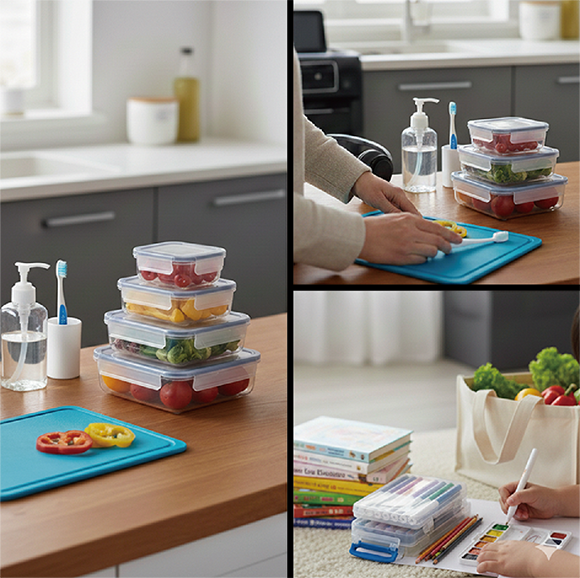
The Resilient "Living Hinge" Material: Getting to Know the Ubiquitous PP (Polypropylene)
In our daily lives, PP (Polypropylene) is a true all-rounder. From the lids of your favorite coffee shop to microwaveable food containers and automotive bumpers, its presence is felt everywhere. Today, TSI (Tan Star) takes you on a deep dive into this material from a professional perspective, and how our precision design ensures its perfect formation.
1. Why is PP the Top Choice for Everyday Products?
PP possesses several irreplaceable qualities that make it a staple in both consumer and industrial sectors:
-
Extreme Toughness: Known as the "Living Hinge" plastic, it can be bent and folded repeatedly without breaking, making it ideal for flexible joints.
-
Heat Resistance and Safety: With a high melting point (160°C - 170°C), it is one of the few plastics (labeled as No. 5) safe for microwave heating.
-
Lightweight and Moisture-Proof: It has a very low density (it can even float on water) and absorbs almost no moisture, making it the best choice for lightweight products.
2. Perfect PP Products Stem from TSI's Precision Geometric Design
While PP is common, maintaining stable quality on the production line is quite a challenge. PP reacts quickly when melting and has a high cooling shrinkage rate. If the screw design is improper, defects like bubbles, sink marks, or uneven coloring can easily occur. At TSI, we overcome these hurdles through expert design:
Tailor-Made Screw Geometric Parameters PP pellets require extremely uniform heating to achieve optimal flow. The TSI R&D team precisely calculates the Compression Ratio and flight depths based on the MFI (Melt Flow Index) of the customer's specific resin. Our specialized designs ensure the melt is completely homogenized within the barrel, eliminating surface defects on the final product.
Rigorous Processing Precision to Boost Productivity During PP production, backflow is a major cause of decreased efficiency. Leveraging high-precision manufacturing, TSI controls the clearance between the screw and the barrel to an ideal limit. This not only stabilizes injection pressure but also shortens cycle times, directly increasing customer productivity.
Optimized Flow Channel Design to Reduce Thermal Degradation Although PP is relatively stable, staying too long in the barrel can lead to thermal degradation and yellowing. TSI's screw structures are optimized to minimize dead spots, ensuring every bit of material passes through smoothly, maintaining the color and mechanical strength of the product.
3. Common Applications of PP Around Us
With precision design support, PP is consistently transformed into high-quality items:
-
Food & Packaging: Microwave containers, disposable cutlery, coffee cup lids, and snack packaging (OPP).
-
Automotive Industry: Lightweight bumpers, dashboards, door panels, and battery casings.
-
Medical & Lifestyle: Melt-blown fabric for surgical masks, disposable syringes, and durable storage bins.
4. Conclusion: Small Material, Big World
Behind seemingly simple PP products lies the expertise of specialists like TSI, who bridge the gap between geometric mechanics and fluid dynamics.
TSI (Tan Star) continues to refine our design capabilities to provide the most stable and efficient solutions for your PP production lines.