
Functional Analysis of Shot Peening (Tan Star TNP) in Screws and Metal Components
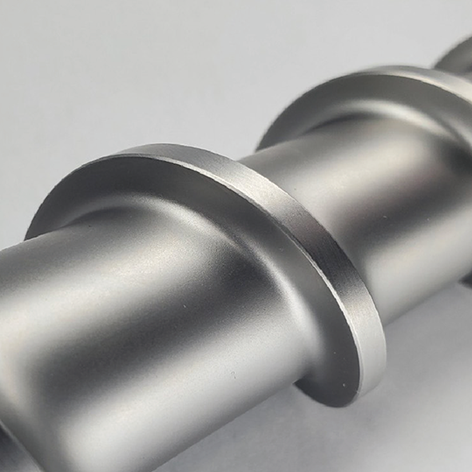
Functional Analysis of Shot Peening (Tan Star TNP) in Screws and Metal Components
— Metal Surface Modification Engineering: The Key Technology for Reducing Friction Coefficient and Enhancing Flow Efficiency
In plastic extrusion and injection molding processes, one of the core factors affecting productivity and stability is not only material hardness or alloy composition, but also:
The friction behavior between metal surfaces and processing materials.
Shot Peening (Tan Star TNP) is a metal surface modification engineering technology.
Through precisely controlled peening treatment, it alters the microstructure of the metal surface to achieve:
-
Reduced effective friction coefficient
-
Optimized polymer flow behavior
-
Improved processing stability
-
Enhanced energy efficiency
In high-performance screws and precision metal components, this surface engineering approach has become an integral part of product design.
Shot Peening (Tan Star TNP): Surface Modification, Not Just Surface Treatment
Unlike sandblasting or polishing, Shot Peening is not intended for cleaning or decorative purposes.
Instead, it applies high-velocity controlled impacts to induce plastic deformation on the metal surface, forming a uniform and stable microstructure.
This surface modification delivers two key mechanisms:
Reduction of Effective Contact Area
At the microscopic level, polymer melt does not fully adhere to metal surfaces but contacts them at discrete points.
After Shot Peening treatment:
-
Continuous surface contact becomes micro-point contact
-
Effective contact area is reduced
-
Boundary friction resistance decreases
This directly influences melt transport and shear behavior.
Formation of a Dynamic Slip Interface
Under high-temperature molten conditions, polymer melt partially fills the micro-dimpled surface structure, forming a stable slip layer.
The results include:
-
Reduced boundary friction
-
Improved shear stability
-
More uniform flow behavior
This effect is particularly significant when processing high-viscosity materials and fluoropolymers such as Teflon.
Engineering Benefits in Screws
For injection and extrusion screws, friction control directly affects processing quality and energy consumption.
Improved Material Conveying and Plasticizing Efficiency
Excessive friction may lead to:
-
Shear overheating
-
Polymer degradation
-
Black specks or carbonization
-
Back pressure fluctuations
After optimization through Shot Peening (Tan Star TNP):
-
Melt flow becomes more stable
-
Shear heat is reduced
-
Plasticizing becomes more uniform
Reduced Torque Load and Energy Consumption
A lower friction coefficient means:
-
Reduced rotational resistance of the screw
-
Lower motor load
-
Improved energy efficiency
This significantly enhances equipment stability during continuous production.
Enhanced Stability for High-Viscosity and Highly Filled Materials
Examples include:
-
High molecular weight polymers
-
High glass-fiber formulations
-
Fluoropolymer engineering plastics
These materials typically exhibit poor flowability and high boundary resistance.
Surface microstructure optimization helps reduce material stagnation and localized shear concentration, improving overall processing consistency.
Why Not Simply Use Mirror Polishing?
Mirror polishing reduces surface roughness values, but under high-temperature and high-pressure processing conditions it may cause:
-
Surface adhesion
-
Melt sticking effects
-
Unstable slip behavior
The advantage of Shot Peening (Tan Star TNP) lies in:
Optimizing dynamic friction behavior rather than merely lowering Ra values.
In real processing environments, controlled microstructures provide superior stability.
Applications in Mold and Cutting Tool Industries
As a metal surface modification engineering technology, Shot Peening (Tan Star TNP) is also widely applied in molds and cutting tools.
Mold Core / Mold Cavity
Mold cores directly contact molten polymer, and their surface condition affects:
-
Demolding efficiency
-
Surface quality
-
Filling completeness
-
Mold lifespan
After Shot Peening treatment, benefits include:
-
Reduced polymer adhesion
-
Improved filling and flow stability
-
Reduced flow marks and weld line issues
-
Lower risk of surface micro-cracking due to thermal cycling
This is especially critical in precision molding and high-surface-quality applications.
Milling Cutters and Cutting Tools
In metal machining, cutting tools endure:
-
High-speed rotation
-
High contact stress
-
Elevated cutting temperatures
By optimizing surface microstructure through Shot Peening (Tan Star TNP), it is possible to:
-
Reduce friction between tool and workpiece
-
Minimize built-up edge formation
-
Lower cutting temperature rise
-
Extend tool life and improve machining stability
This is particularly important in high-speed and five-axis machining environments.
Engineering Summary
The core value of Shot Peening (Tan Star TNP) in screws, molds, and cutting tools lies in its role as:
A metal surface modification engineering technology
A friction control solution
A flow optimization strategy
By controlling surface microstructure, it enables:
-
Reduced friction coefficient
-
Enhanced polymer flowability
-
Lower energy consumption
-
Improved processing stability
-
Extended tool and mold life
In advanced manufacturing industries, true competitiveness often comes from these invisible surface engineering details.