
Why High Hardness Does Not Equal Long Service Life? Uncovering the Truth Behind Injection Screw Longevity
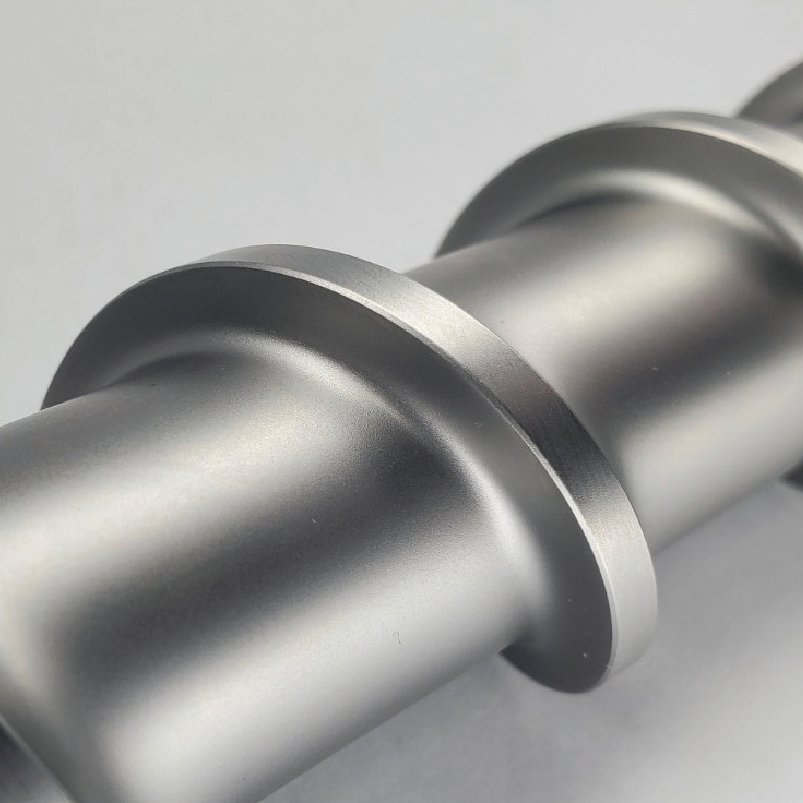
Why High Hardness Does Not Equal Long Service Life? Uncovering the Truth Behind Injection Screw Longevity
In the injection molding industry, the screw is often regarded as the "heart" of the machine. When a screw wears out, the most common request is: "Can we make it harder? That should make it last longer."
However, from the perspective of materials science, hardness and service life are not in a simple linear relationship. Blindly pursuing extreme hardness can sometimes shorten the screw's life. This article analyzes the key factors for true longevity through material properties, chemical compositions, and advanced processing technologies.
1. The Balance Between Hardness and Toughness
First, we must distinguish between Hardness (resistance to wear/scratching) and Toughness (resistance to fracture/breaking).
In materials science, there is a "trade-off": as hardness increases through heat treatment, the material becomes more brittle. Injection screws operate under high pressure, high torque, and thermal stress. If a screw is too hard and lacks toughness, it cannot absorb the impact of unmelted resin or metal contaminants, leading to flight chipping or even a catastrophic snap (fracture).
2. The Soul of the Screw: Chemical Composition
True longevity depends on the precise balance of alloying elements:
-
Chromium (Cr) & Molybdenum (Mo): Enhance thermal stability and grain refinement, ensuring the screw doesn't soften under high temperatures ($250^{\circ}\text{C}+$).
-
Vanadium (V) & Niobium (Nb): Form hard carbides that act as "invisible armor" against abrasive glass fibers (GF), even if the overall Rockwell hardness remains the same.
3. Advanced Technologies for Overcoming the Longevity Bottleneck
To break the limit of the "Hardness vs. Toughness" conflict, three advanced solutions are widely used:
-
Bimetallic Technology: This uses a high-toughness alloy steel as the base to support torque, with a 1.5-2.0mm wear-resistant alloy layer welded only on the flight tops. It ensures the screw is "flexible enough not to break, yet hard enough not to wear."
-
HVOF (High-Velocity Oxy-Fuel) Coating: Tungsten carbide (WC-Co) particles are sprayed at supersonic speeds onto the surface. HVOF creates a dense, low-porosity barrier with minimal thermal impact on the base material, making it the top choice for high-GF or corrosive environments.
-
Powder Metallurgy (PM) Steel: Created through High-Pressure Gas Atomization and Hot Isostatic Pressing (HIP). PM steels feature an extremely uniform microstructure, eliminating the "weak points" found in conventional cast steels. Even at $HRC 60+$, PM steel maintains incredible fatigue resistance and toughness.
Conclusion
A long-lasting screw is not about the highest HRC number; it is about having a tough core to withstand pressure and a tailored surface to resist specific wear. Balanced hardness is the true guarantee of longevity.